If you run a hospital ward, a council service, a law firm or an HR team, sooner or later someone will need help in a language you do not speak. Choosing the right language services UK providers offer is the difference between a clear conversation and a costly misunderstanding. This guide explains what language services cover, who needs them and how to pick a provider you can trust.
Table of contents
The UK is one of the most linguistically diverse countries in Europe. Schools, GP surgeries, courts and councils deal with dozens of languages every week. At Maguire Languages we support organisations from our base in Glasgow, and we see the same questions come up again and again. Here is a plain-English guide to language services for organisations across the UK.
What are language services in the UK?
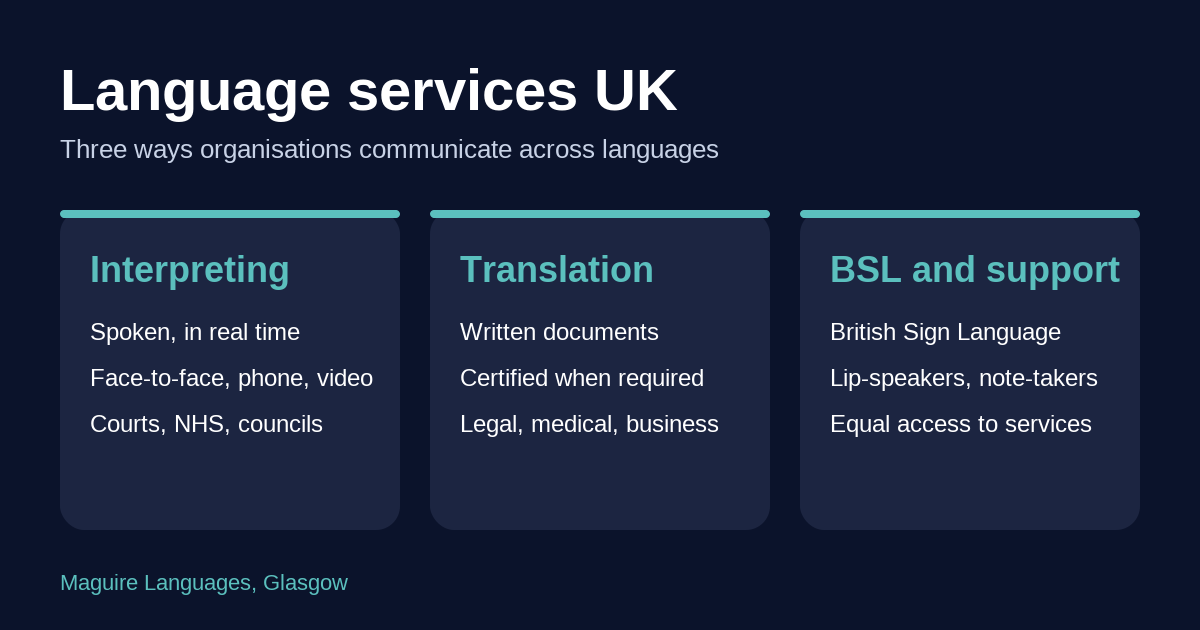
Language services is the umbrella term for any professional help that lets people understand each other across languages. In the UK, it usually covers four things.
Interpreting
Interpreting is spoken. A trained interpreter converts what one person says into another language in real time, either after each sentence (consecutive) or as the speaker talks (simultaneous). It is used in court hearings, hospital appointments, social work visits and meetings. Our interpreting services cover face-to-face, telephone and video sessions.
Translation
Translation is written. A translator converts a document into another language while keeping its meaning, tone and legal weight. That includes letters, contracts, medical records, leaflets and websites. See our translation services for the full range, including documents that need certification.
British Sign Language and communication support
British Sign Language (BSL) is a language in its own right, not a signed version of English. BSL has legal recognition in the UK, including under the British Sign Language Act 2022 and the BSL (Scotland) Act 2015. Deaf and hard of hearing people may also need lip-speakers or note-takers.
Related services
Many organisations also need transcription, proofreading of translated material and checking of multilingual website content. A good provider handles these alongside interpreting and translation, so you do not need three suppliers.
Who uses language services across the UK?
Almost every public-facing organisation needs language services UK wide at some point. The table shows the most common situations.
| Sector | Typical need | Service |
|---|---|---|
| Courts and solicitors | Hearings, client meetings, evidence and witness statements | Legal interpreting and legal translation |
| NHS and healthcare | Consultations, consent, discharge letters, patient information | Medical interpreting and translation |
| Councils and social work | Housing, assessments, child and adult protection meetings | Face-to-face and telephone interpreting |
| Education | Parent meetings, admissions, qualification checks | Interpreting and certified translation |
| Employers and HR | Right-to-work checks, disciplinary meetings, staff handbooks | Translation and business interpreting |
| Charities and housing associations | Advice sessions, leaflets, tenant communications | Telephone interpreting and translation |
If your work crosses borders, you may also need a certified document. Our guide to certified, notarised and sworn translation explains which type each authority accepts.
Public bodies in the UK have duties under equality law, including the Equality Act 2010, to make services accessible. Language is part of that. Check the exact duty that applies to your organisation with your legal or compliance team.
Interpreting formats explained
The right format depends on the setting, the length of the session and how sensitive the conversation is.
| Format | Best for | Watch out for |
|---|---|---|
| Face-to-face | Court hearings, mental health assessments, long or emotional meetings | Needs more notice and travel time |
| Telephone | Short enquiries, urgent calls, rare languages at short notice | No body language, so it is less suited to complex or sensitive cases |
| Video | Remote hearings, GP appointments, meetings across several sites | Needs a stable connection and a quiet room |
Whichever format you pick, the interpreter should be briefed beforehand. A short note on who is attending and what will be discussed makes a real difference to accuracy.
How to choose language services UK providers
Not all language services UK providers offer the same standard. Before you sign a contract or book a first session, check these six things.
- Qualified linguists. Ask whether interpreters hold a recognised qualification such as the Diploma in Public Service Interpreting (DPSI) and whether they appear on the National Register of Public Service Interpreters. Translators should be qualified or experienced members of professional bodies such as the Chartered Institute of Linguists.
- Quality standards. ISO 17100 covers translation services and ISO 18841 covers interpreting services. A provider that follows them has a documented process for checking work.
- Confidentiality and data protection. Linguists often handle medical, legal and personal data. Ask how the provider complies with UK GDPR and whether linguists sign confidentiality agreements.
- Sector experience. A court interpreter and a hospital interpreter need different vocabulary and different ethics training. Ask for examples from your sector.
- Coverage and speed. Can they supply the languages you need, including Welsh, Scottish Gaelic and less common dialects, across all the UK nations? How quickly can they respond to urgent requests?
- Clear pricing. You should get a quote that states rates, minimum booking times and cancellation terms in advance.
A provider that answers these questions clearly and quickly is usually one you can rely on for language services UK wide. A vague answer is a warning sign.
Language services UK pricing: what affects the cost
There is no single price list for language services UK buyers can compare like for like, because every job is different. These factors move the price most.
- Language. Common languages have many qualified linguists, so rates are lower. Rare languages and dialects cost more because fewer professionals are available.
- Type of work. Legal, medical and technical work is specialist and usually priced higher than general text or conversation.
- Length. Translation is usually charged by word count, and interpreting by the hour or half day, often with a minimum booking time.
- Urgency. Same-day and out-of-hours requests usually carry a premium.
- Format. Telephone interpreting is often cheaper than face-to-face because there is no travel time.
- Certification. A certified or notarised translation costs more than a standard one because of the extra checks and paperwork.
Ask every provider for a written quote that lists these items separately. It makes comparing offers fair and removes surprises on the invoice.
6 mistakes organisations make
Most problems with language support are avoidable. These are the ones we see most often.
- Using family members or colleagues to interpret. They may not know the specialist terms, may leave things out to protect someone, and are not impartial. Children should never be asked to interpret.
- Relying on machine translation for important documents. Free tools are fine for a rough idea. They are not safe for contracts, medical information or court papers.
- Booking too late. Rare languages and specialist interpreters need notice. Book as soon as an appointment or hearing is confirmed.
- Skipping the briefing. An interpreter who sees the case papers or agenda in advance will be faster and more accurate.
- Ignoring dialect and script. Arabic, Kurdish and Chinese, for example, each have important variants. Asking for the right one avoids confusion.
- Choosing on price alone. The cheapest quote often means unqualified linguists and no quality check. A rejected translation or a failed hearing costs far more.
How booking language services works
Booking professional language services UK wide is simpler than many organisations expect.
- Tell us what you need. The language, the setting, the date and whether it is interpreting, translation or both.
- Get a clear quote. Based on language, length, format and deadline, with no hidden extras.
- We match the right linguist. Someone with experience in your sector, vetted and bound by confidentiality.
- We brief and deliver. Interpreters receive the key details beforehand. Written work is translated by a specialist.
- Quality check and follow-up. Translations are reviewed by a second linguist before delivery. You can give feedback after every job.
For ongoing needs, such as a council department or a firm with regular clients, a standing arrangement saves time on every booking.
Buying language services UK public bodies can rely on
If you buy for a council, health board, court service or housing association, your needs go beyond a good price. You also need a supplier that is reliable, auditable and easy to work with. Before you appoint a provider of language services UK wide, consider asking for:
- References from similar organisations in your sector, so you can see how the provider performs in practice.
- A clear complaints and feedback process, so problems are recorded and fixed.
- Proof of linguist vetting, including identity checks and, where the work requires it, background checks.
- Service levels in writing, such as response times for urgent requests and what happens if an interpreter cannot attend.
- Management information, such as booking volumes and languages used, so you can plan and report.
Procurement rules differ between England, Scotland, Wales and Northern Ireland, so check which rules apply to your organisation before you tender.
Machine translation and AI: where they help
Machine translation and AI tools are useful, and they are improving quickly. They can help you understand the gist of a short message, draft internal notes or translate low-risk text at speed. They are a poor fit when the stakes are high.
Avoid relying on them for legal documents, medical information, safeguarding conversations or anything that will be sent to an authority. A tool cannot take responsibility for its mistakes, cannot certify a translation and may miss tone, idiom or cultural context. The safest approach is to use a qualified linguist for important work. The best language services UK organisations use often combine technology for speed with human review for accuracy.
How to prepare for an interpreted meeting
A little preparation helps every interpreter, whichever provider you use.
- Share the basics early. Send the agenda, names and any technical terms or documents before the session.
- Speak to the person, not the interpreter. Keep eye contact with the person you are talking to.
- Use short, clear sentences. Pause often so nothing is lost. Avoid jargon and idioms.
- Allow extra time. Interpreted meetings take noticeably longer than meetings held in one language.
- Let the interpreter clarify. They may stop to check a term. That is a sign of care, not delay.
- Debrief afterwards. Ask whether anything was unclear, and record that an interpreter was used.
Following these steps gets more value from any language services UK provider you book, and it protects the person who needs the help.
Language services in Glasgow and across the UK
Maguire Languages is based at 137 Ingram Street in Glasgow and works with organisations throughout the UK. Our team supports courts, healthcare providers, councils and private clients in over 100 languages, and combines local knowledge of Scottish systems with the ability to serve clients in England, Wales and Northern Ireland.
If you are based in Glasgow, our guide to interpreting and translation services in Glasgow covers what is available locally. If you need a document accepted by a UK authority, read our guide to certified translation UK services.
Frequently asked questions
What are language services?
Language services are professional services that help people communicate across languages. They include interpreting, translation, British Sign Language support and related work such as transcription and proofreading.
What is the difference between an interpreter and a translator?
Interpreters work with spoken language, usually in real time. Translators work with written text. Many professionals specialise in one or the other, and good providers offer both.
How much do language services cost in the UK?
Prices depend on the language, the length of the job, the format and how urgent it is. Rare languages and short-notice bookings usually cost more. A good provider will give you a written quote before any work starts.
Do I need a qualified interpreter, or can a bilingual colleague help?
For anything legal, medical or sensitive, use a qualified, impartial interpreter. A bilingual colleague may not know specialist terms and cannot be neutral. Using one can put accuracy and confidentiality at risk.
Can you provide interpreters at short notice?
Often yes, especially by telephone or video. In-person interpreters and rarer languages need more notice, so book as early as you can. Contact us with the details and we will confirm what is possible.
Do you work outside Glasgow?
Yes. Maguire Languages is based in Glasgow and supports clients across the UK, using face-to-face, telephone and video interpreting and remote translation.
Is my information kept confidential?
Yes. Our linguists work under confidentiality requirements and your documents and conversations are handled in line with UK data protection law.
How do I find reliable language services UK providers?
Check that linguists are qualified and listed on professional registers, ask for references from your sector and confirm the provider follows recognised quality standards. A reliable provider will answer these questions clearly and give you a written quote.
Can machine translation replace a professional translator?
Not for important work. Machine translation can help you grasp the meaning of a short text, but it cannot certify a document or take responsibility for errors. Use a qualified translator for legal, medical and official documents.
Do you provide British Sign Language support?
Maguire Languages offers BSL support as part of its language services. Contact us with the date, location and setting, and we will confirm availability and send a quote.
Need language services UK wide?
Tell Maguire Languages what you need, the language and the date. We will recommend the right mix of interpreting and translation and send a clear quote, with confidential service across the UK from our base in Glasgow.
