
You’ve been told you need a certified translation UK authorities will accept. Then someone says it has to be notarised. Then a form from abroad asks for a “sworn” translation. Pick the wrong one and your document comes back rejected, usually right before a deadline. This guide explains the difference and which one you need.
Table of contents
At Maguire Languages we see this every week in Glasgow, from Sheriff Court bundles to visa files and university applications. Here is what each type of certified translation UK bodies ask for actually means, when you need it, and the small mistakes that get good translations sent back.
Certified, notarised and sworn translation: the difference
What is a certified translation UK authorities accept?
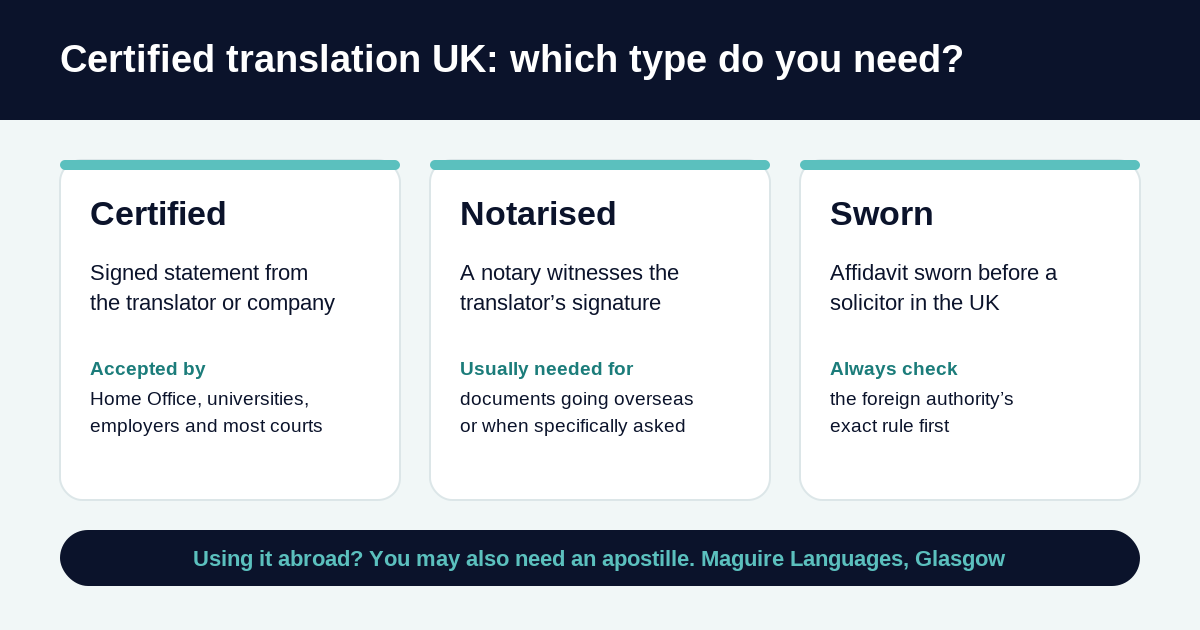
This is what most UK bodies mean. A certified translation comes with a signed statement from the translator or translation company confirming it is a true and accurate translation of the original. It includes the date, the translator’s full name and their contact details.
The Home Office, UK universities, employers and most courts accept it. For most people, it is all you need.
What is a notarised translation?
A notary public checks the translator’s identity and witnesses them signing a declaration that the translation is accurate. The notary confirms the signature, not the language.
It is usually needed when a document is going overseas, or when a foreign authority or court specifically asks for it. In Scotland, notaries are practising solicitors.
What is a sworn translation in the UK?
The UK does not have an official system of sworn translators the way Spain, France or Italy do. When a UK document needs a sworn translation, the translator usually swears an affidavit before a solicitor or commissioner for oaths.
If a foreign authority insists on a sworn translator from their country, a UK translation will not be accepted. Always check what the receiving body means.
What is an apostille translation?
Some countries also want an apostille, issued by the UK’s Foreign, Commonwealth & Development Office. It confirms the notary’s signature is genuine. You only need it for documents being used outside the UK.
\n
Which certified translation UK option do you need?
If you are unsure which certified translation UK organisations expect, ask the one receiving the document before you order anything.
| Situation | What you usually need |
|---|---|
| UK visa or settlement application | Certified translation |
| UK university or college application | Certified translation |
| Job application or right-to-work checks | Certified translation |
| Court papers and evidence in a UK case | Certified translation (legal translation services) |
| NHS or GP medical records | Certified translation |
| Marriage or business abroad | Notarised translation, often with an apostille |
| Property or inheritance overseas | Notarised translation, often with an apostille |
| Foreign authority asks for “sworn” | Check their exact rule: affidavit in the UK, or a sworn translator in their country |
If you are also attending a hearing or appointment, you may need an interpreter as well. Our interpreting services cover courts, hospitals and councils across the UK.
6 reasons certified translations get rejected
Most rejections have nothing to do with the language. They come down to small details.
- The certification statement is missing something. No date, no signature, no contact details. Each one is enough for a rejection.
- Stamps and handwriting were skipped. Official seals, margin notes and handwritten additions on the original need translating too, or at least noting.
- Names don’t match. A name spelled one way on the passport and another on the translated certificate raises flags. Translators should follow the spelling on your ID.
- Pages are missing. The back of a certificate or an annex counts. If it is on the original, it belongs in the translation.
- It’s a summary, not a full translation. Official bodies want the complete document, word for word in meaning.
- You translated it yourself. Even if you’re fluent, most UK authorities won’t accept a translation by the applicant or a family member.
Get these right and your certified translation UK authorities review is accepted first time, saving weeks of resubmitting and rebooking.
How certified document translation works
Ordering a certified translation UK wide is simpler than most people expect.
- Send a clear scan or photo. Every page, front and back. You rarely need to post the original.
- Tell us where it’s going. Home Office, a university, a Sheriff Court, an embassy. That decides whether it is certified, notarised or needs an apostille.
- Get a fixed quote. Based on language, length and deadline. No surprises later.
- A specialist translates it. Legal documents go to legal translators, medical records to medical translators.
- Checked and certified. A second linguist reviews it, then we add the signed certification statement.
- Delivered your way. A signed PDF by email, with hard copies posted if the receiving body wants them.
Because it all works online, you can use our translation services UK wide, from anywhere in the country. You can also read more on where translation services are needed across the UK.
Certified translation in Glasgow
Glasgow has its own mix of paperwork, and it helps to use a certified translation UK provider that knows it.
- Courts and tribunals. Glasgow Sheriff Court is one of the busiest in the UK, and the city also hosts High Court and immigration tribunal hearings. Legal translation services here need to follow Scots law terms, not English ones.
- Healthcare. NHS Greater Glasgow and Clyde is Scotland’s largest health board. Patient records, discharge letters and consent forms come through in dozens of languages.
- Universities. The University of Glasgow, Strathclyde and Glasgow Caledonian take thousands of international students, most needing certified transcripts and diplomas.
- Communities and councils. Glasgow is one of the UK’s main centres for resettlement, so Glasgow City Council, housing associations and schools rely on clear translated letters and forms.
Maguire Languages is based in Glasgow, so we know how these institutions want documents presented. When a translated document leads to a hearing or appointment, we can arrange local interpreters too, with translation and interpreting translation services under one roof.
Frequently asked questions
Does the Home Office accept certified translations?
Yes. The Home Office requires a certified translation for any document not in English or Welsh. It must confirm the translation is accurate and include the date, the translator’s full name and signature, and their contact details.
Is a notarised translation better than a certified one?
Not better, just different. A notarised translation adds a notary’s check on the translator’s identity and signature. It is only worth paying for if the receiving body asks for it.
Are there sworn translators in the UK?
Not in the formal sense used in many European countries. In the UK, a sworn translation usually means the translator has sworn an affidavit before a solicitor.
Do I need to send my original document?
Usually not. A clear scan or photo of every page is enough for most certified translations.
How long does a certified translation take?
A single certificate can often be turned around in one to two working days. Longer legal or medical files take more time depending on length and subject.
Where can I get a certified translation in Glasgow?
Maguire Languages provides certified translation services in Glasgow for personal, legal, medical and business documents. Send a scan of your document online and we will come back with a quote, wherever you are in the city or the UK.
Can a certified translation be used in Scotland and England?
Yes. A certified translation UK bodies request is accepted across the UK, including by Scottish courts, NHS boards and councils.
Not sure which certified translation you need?
Tell us what the document is and where it is going. Maguire Languages will tell you exactly which type you need, then deliver a certified translation UK authorities accept, with confidential service across the UK from our base in Glasgow.
